Article | Adaptive Spaces
Business Insights | Future-Proofing Footprint: Optimising Asia Pacific Life Sciences Location Strategy
September 23, 2026

Contact Us
Senior Director, Life Sciences, Transaction Management, Asia Pacific

Director, Head of Consulting, Advisory Services, Asia Pacific

Introduction: An Evolving Geography
The Asia Pacific life sciences industry is in a state of flux, driven by shifting global supply chains, rising medical inflation, and a strong pivot toward regional innovation.As the industry re-aligns, life sciences companies in the region are increasingly adopting multi-market operating models that designate functions according to talent availability, cost competitiveness, supply chain resilience and regulatory requirements; trends that have far-reaching implications for location and real estate requirements.
CBRE’s Global Labor & Location Advisory practice, together with CBRE’s Life Science Vertical, has compiled an essential list of must-knows for occupiers looking to navigate Asia Pacific’s evolving life sciences geography.
The Backdrop
Manufacturing and R&D grab lion’s share of FDI
Manufacturing and R&D together account for nearly 80% of life sciences industry capital investment in Asia Pacific, reflecting the sector's dual-axis strategy of scaling production in established manufacturing corridors and emerging “plus one hubs”, while concentrating R&D in talent-rich, cost-efficient markets.[1]China plays a key role in the region’s manufacturing base, with 40% of manufacturing investment directed into this market [2], while India, Vietnam and the Philippines are capturing diversified greenfield growth across emerging hubs. R&D remains concentrated in China and India, which collectively accounted for 76% of R&D investment in 2025, [3] backed by these markets’ deep talent pool, clinical trial ecosystems, and significant cost advantages. Singapore is considered an important hub for both R&D and commercial activity.
These trends provide additional evidence of a growing shift from single-market location decisions into multi-market plays that leverage the strength of each market.
Talent depth as a key driver of location selection
Successful life sciences clusters invariably coalesce where talent, infrastructure, facilities, manufacturing capacity and other critical environment drivers converge.Although market access and growth remain key, skilled workforce availability is the leading non-market investment motivator, driving 28% of location strategies (Figure 1).
This reflects the life sciences sector's reliance on specialised talent, including R&D and science; manufacturing and quality-control, and digital, AI and bioinformatics, along with the cost efficiency of scaling these capabilities in key markets such as India and China. While the region’s foundational skill base remains stable, quality, digital and AI-driven capabilities are the fastest-growing layer.
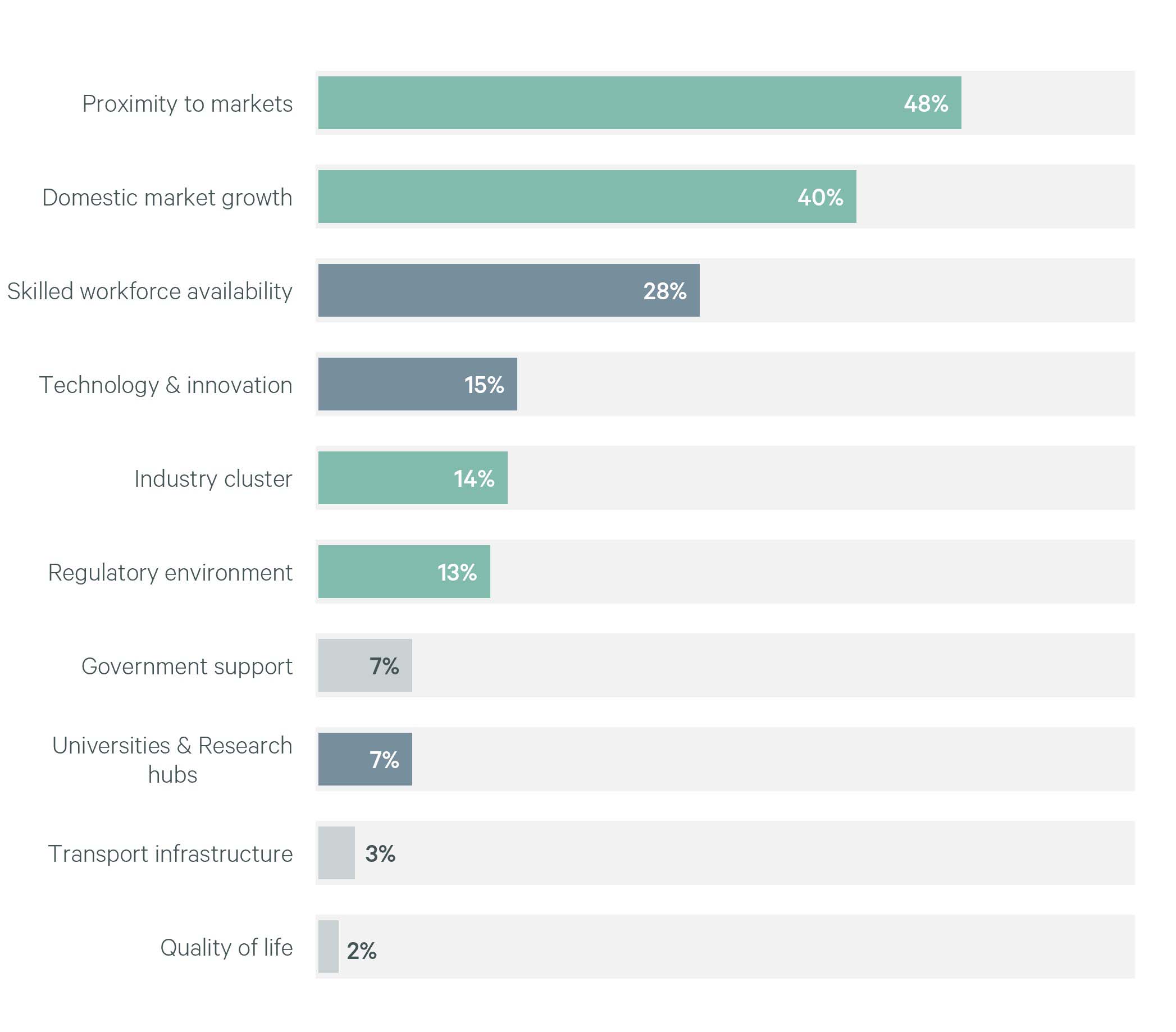
Source: CBRE Labor & Location Advisory & Article Research, August 2026; fDi Markets.
Successful life sciences clusters invariably coalesce where talent, infrastructure, facilities, manufacturing capacity and other critical environment drivers converge. Although market access and growth remain key, skilled workforce availability is the leading non-market investment motivator driving location strategy.
The Macro Trends
Integrating AI into Business Models
Life sciences firms are shifting from isolated AI experiments to comprehensive business model integration. Many companies now use AI platforms, automation, and agentic workflows, especially to accelerate drug discovery. This is shifting the required talent profile and, consequently, locational preference.The prioritisation of AI also extends to recruitment. CBRE recently delivered a labour analytics study for a multinational life sciences company, whose regional strategy identified AI-talent availability as a primary driver. Locations capable of providing workers with the requisite AI skills will therefore command a distinct advantage.
Growth in M&As, Demergers & Spin-Offs
Life sciences M&A, demergers and spin-offs in Asia Pacific are accelerating as major firms seek innovative assets, cross-border licensing, and new regional hubs.As the separation of commercial entities forces occupiers to rapidly unwind shared liabilities, fixed, long-dated leases are becoming a liability. Several major life sciences multinationals recently carved out their consumer health arms, leaving standalone entities to disentangle a shared Asia Pacific footprint.
This is driving demand for increased agility in real estate operations, with companies looking to quicky resize, relocate and redesign portfolios without getting bogged down in costly, long-term contracts as their business models continue to evolve.
A recent CBRE Life Science Vertical review of life science clients combined with live market data revealed a clear trend of regional and country headquarters' downsizing, sometimes by as much as 15%.
Managed solutions are emerging as a popular option, with formats ranging from membership models and light touch-down spaces to accommodate sales teams all the way to fully-fledged larger offices.
De-risking Supply Chains
Geopolitical tension and regulatory pressure are spurring the regionalisation of the life sciences industry footprint as firms diversify away from single-source dependencies toward localised manufacturing hubs closer to final patient populations.This is prompting companies to prioritise supply continuity and end-to-end traceability over lowest-cost global concentration. Several global pharmaceutical firms recently committed a combined US$18 billion in China through 2030, expanding localised production and R&D capacity, thereby increasing their exposure to a key growth market while also hedging geopolitical risk.
Geopolitical tension and regulatory pressure are spurring the regionalisation of the life sciences industry footprint as firms diversify away from single-source dependencies toward localised manufacturing hubs closer to final patient populations. This is prompting companies to prioritise supply continuity and end-to-end traceability over lowest-cost global concentration.
The Business Strategies
In response to rapidly evolving market conditions, life sciences companies in Asia Pacific are adopting a range of strategies and approaches to ensure successful real estate outcomes. CBRE has summarised these in the infographic below.Conclusion: The Real Estate Solution
With Asia Pacific no longer a single-market play, CBRE recommends life sciences companies adopt a multi-hub strategy that layers several drivers. Instead of choosing a single best city, or considering cost and scale alone, companies should carefully navigate across markets, assigning manufacturing, R&D, digital operations and commercial activities to different locations according to each market's comparative advantage. This will help create a multi-hub strategy that balances talent, risks, incentives, and individual market strengths.Following the data and not what the competition is doing will be key. Mimicking competitors' real estate moves based on a superficial reading of headlines is both risky and undesirable, while shortcuts to achieving speed to market tend to backfire. Life sciences occupiers should clearly articulate their business needs and follow the objective dataset to the recommended solution.
CBRE takes an integrated approach to real estate challenges. Consultancy, Transaction Management, Project Management and Facility Management connect regularly to ensure we share our latest insights based on research and hands-on experience. This will provide occupiers the comfort that CBRE will provide a thought-through strategy based on end-to-end delivery, while maintaining speed to market. For a more in-depth discussion on location & network strategy, talent & labour analytics, and peer & portfolio intelligence, please contact CBRE’s Global Labor & Location Advisory practice.
References
[1] CBRE Labor & Location Advisory, August 2026.
[2] CBRE Labor & Location Advisory, August 2026.
[3] CBRE Labor & Location Advisory, August 2026.
Contacts
Paul Peeters
Senior Director, Life Sciences, Transaction Management, Asia Pacific
Udit Sabharwal
Director, Head of Consulting, Advisory Services, Asia Pacific
Matthew Gardner
Sector President, Life Sciences, CBRE Enterprise

Mark W. Seeley
Executive Vice President
